About ASAGAYA...
Asagaya is the project of French multi-instrumentalist David Kern. Through cinematic and narrative-driven songwriting, his albums unfold as cohesive stories centered on fictional characters. Drawing from late 60s/70s aesthetics, 90s genre-crossing influences and a wide range of global musical traditions, his work blends live instrumentation, layered production and diverse sonic textures, shaped through collaborations with vocalists and musicians.
Before developing Asagaya, Kern was involved in a range of bands across different genres, from rock and funk to fusion and experimental music. This background shaped a musical approach that remains deliberately open, combining structured songwriting with a strong interest in texture, arrangement and cross-genre dialogue.
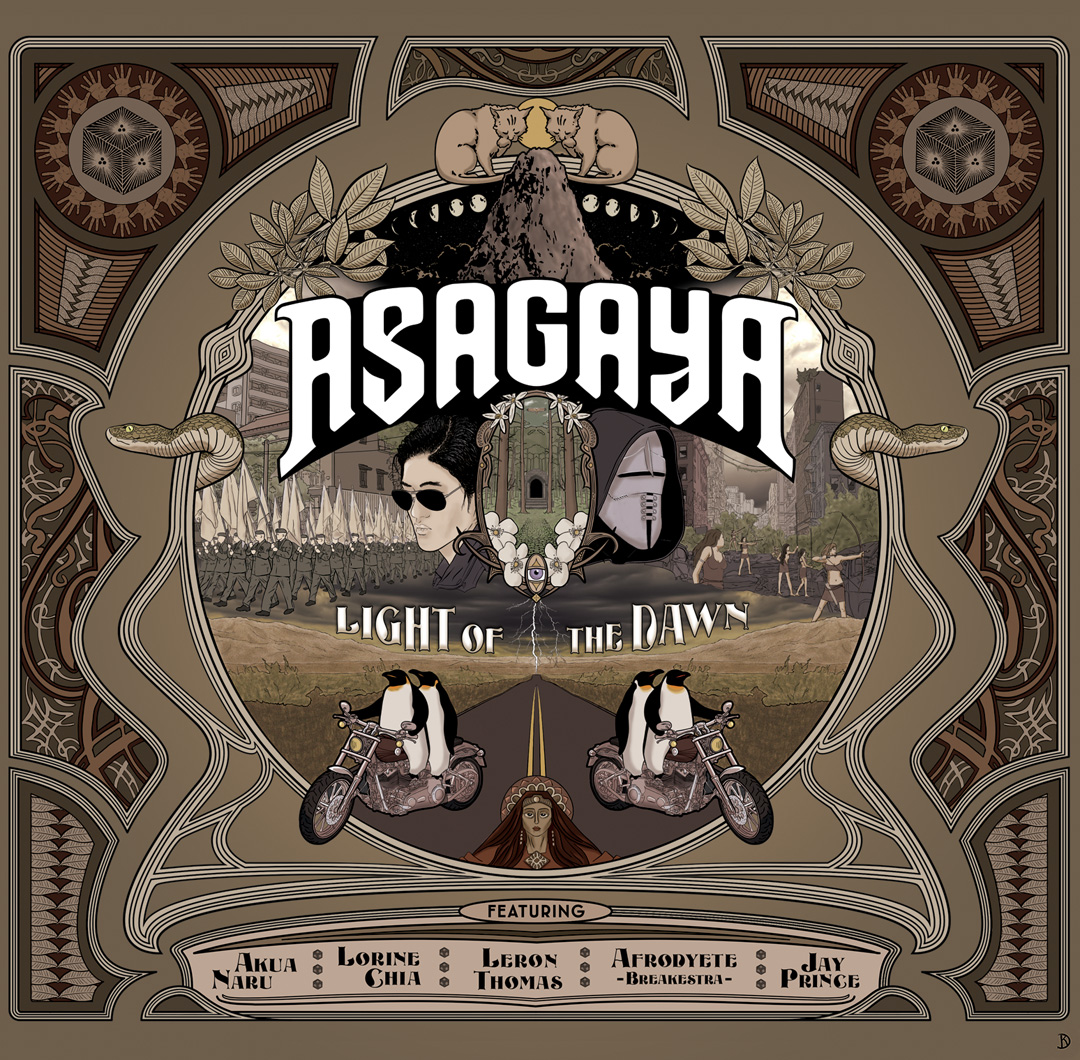
The project took form with the release of Light of the Dawn (2015), produced by Guts and released via Jakarta Records. The album features a range of vocal collaborators, including Leron Thomas, Lorine Chia, Afrodyete, Akua Naru and Jay Prince. It reflects an early form of what would become a defining characteristic of Asagaya: a layered production style combining live instrumentation, vocal features and a broad range of musical references.
Asagaya’s music is structured around a cinematic sensibility and a form of narrative-driven songwriting, where albums are conceived as cohesive arcs. Rather than presenting standalone tracks, the compositions are designed to unfold progressively, each piece contributing to the development of a broader storyline centered on a fictional character.
Asagaya draws from a wide and interconnected musical landscape, rooted in the recording aesthetics and orchestral sensibilities of the late 1960s and early 1970s, as well as the hybrid, genre-crossing energy of the 1990s. These influences range from Frank Zappa to Beastie Boys, Sly and the Family Stone, Parliament-Funkadelic, Jimi Hendrix, The Doors, Dr. John, Sonic Youth, Nirvana, Rage Against the Machine, Beck, Tricky and Aphex Twin, alongside a strong interest in global musical traditions including Fela Kuti and 1970s Anatolian pop.
Rather than adhering to a single stylistic identity, Asagaya operates through juxtaposition and synthesis: analog textures alongside digital processing, orchestral elements alongside rhythm-based production, and influences spanning rock, hip-hop, psychedelic and experimental music.
Kern remains closely involved in all stages of production, from composition and arrangement to recording and sound design, using the studio as a compositional tool. This process results in music that emphasizes detail, transitions and internal coherence, while leaving space for collaboration and reinterpretation.
Through Asagaya, David Kern develops a body of work where music functions as a narrative medium, shaped by contrast and a constant interplay of influences.